Designing Maintainable Test Automation with Page Objects
A practical lesson in separating UI mechanics from test intent, reducing maintenance, and choosing useful abstraction boundaries.
- #architecture
- #clean-code
- #testing
An automation suite becomes expensive to maintain when every test knows the details of the interface it exercises. A locator change then spreads across otherwise unrelated scenarios. I encountered this problem while working on test automation and addressed it with the Page Object Model.
Identify the responsibility that changes
The issue was duplicated knowledge. Tests contained both the scenario being verified and the mechanics needed to navigate the UI. Those responsibilities changed for different reasons.
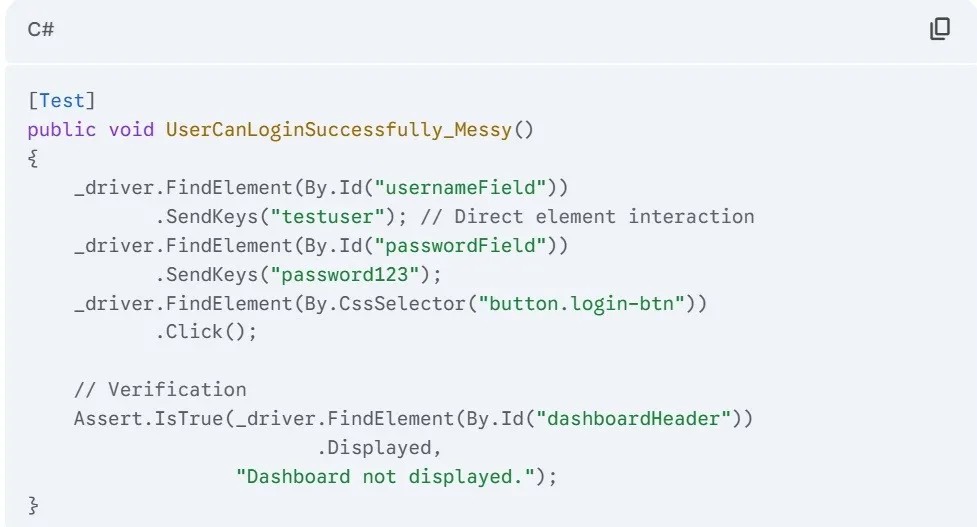
A colleague introduced me to page objects: classes that own locators and expose operations meaningful to their callers. The test can express a login scenario while the page object handles the relevant controls.
Move UI mechanics behind a focused interface
I started with the login flow. The page object held the locators and interactions; the test supplied its inputs and checked the result. A locator update could then be made in one place.
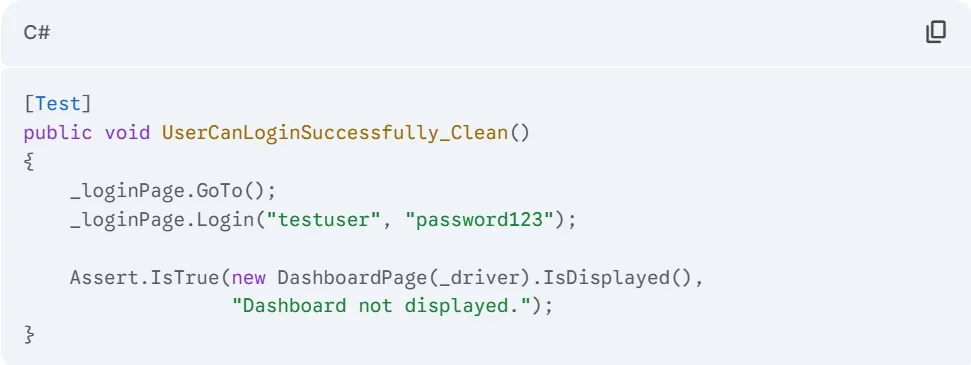
The benefit came from placing related changes together. A page object still needs maintenance, and a redesigned workflow may require test changes. The abstraction reduces duplication without removing the need to understand the product.
Keep the boundary useful
A useful page object exposes actions such as entering credentials or submitting a form. Exposing every raw element simply relocates the locators while leaving tests coupled to the screen's structure.
Keep scenario-specific assertions in the tests where practical, and avoid turning one page object into a framework for every possible interaction. The interface should remain easy to read and debug.
Apply the same reasoning elsewhere
This was an early lesson in separation of concerns that transferred directly to backend work. Service adapters, data-access boundaries, and test doubles are useful when they isolate a responsibility that changes independently.
Before adding an abstraction, I ask what it protects, which duplication it removes, and whether it makes the caller easier to understand. The value is in the change it simplifies.